

M101-5: Guiding Principles of Modeling
10m Read
In the last module, we explored why so many models falter—scope creep, limited capacity, runaway complexity, and loss of institutional knowledge.
This module reframes those challenges as opportunities. The Guiding Principles of Modeling outline how public-sector organizations can turn fragile, spreadsheet-bound models into durable decision frameworks.
These principles are not about perfection; they are about purpose and continuity. When applied together, they create a modeling discipline that scales with your institution, adapts to change, and earns lasting confidence from boards, councils, and communities alike.
Section 1
Set Goals
Every model begins with a question — but many start without one.
When objectives are vague, models expand endlessly, producing output that looks precise but lacks purpose. The remedy is deliberate goal-setting: deciding exactly what the model must inform before any data is entered.
A strong model defines its boundaries:
- Identify the decision to be made, not just the data to be gathered.
- Define success criteria early — sustainability? affordability? compliance?
- Consider the audience — what clarity do council members, trustees, or the public need to act with confidence?
- Align timing with decision windows — a perfect model delivered too late fails its purpose.
Setting goals upfront transforms modeling from data exploration into decision enablement. It replaces confusion with focus — and ensures the model serves its institution, not the other way around. A model tied to clear objectives becomes a decision-making instrument, not just an analytical exercise.
Section 2
Set Expectations
Many models collapse not from bad math, but from misplaced ambition. Teams overreach, trying to account for every variable before they’ve proven the structure works. In the public sector, where resources and timelines are tight, this approach can be fatal to momentum.
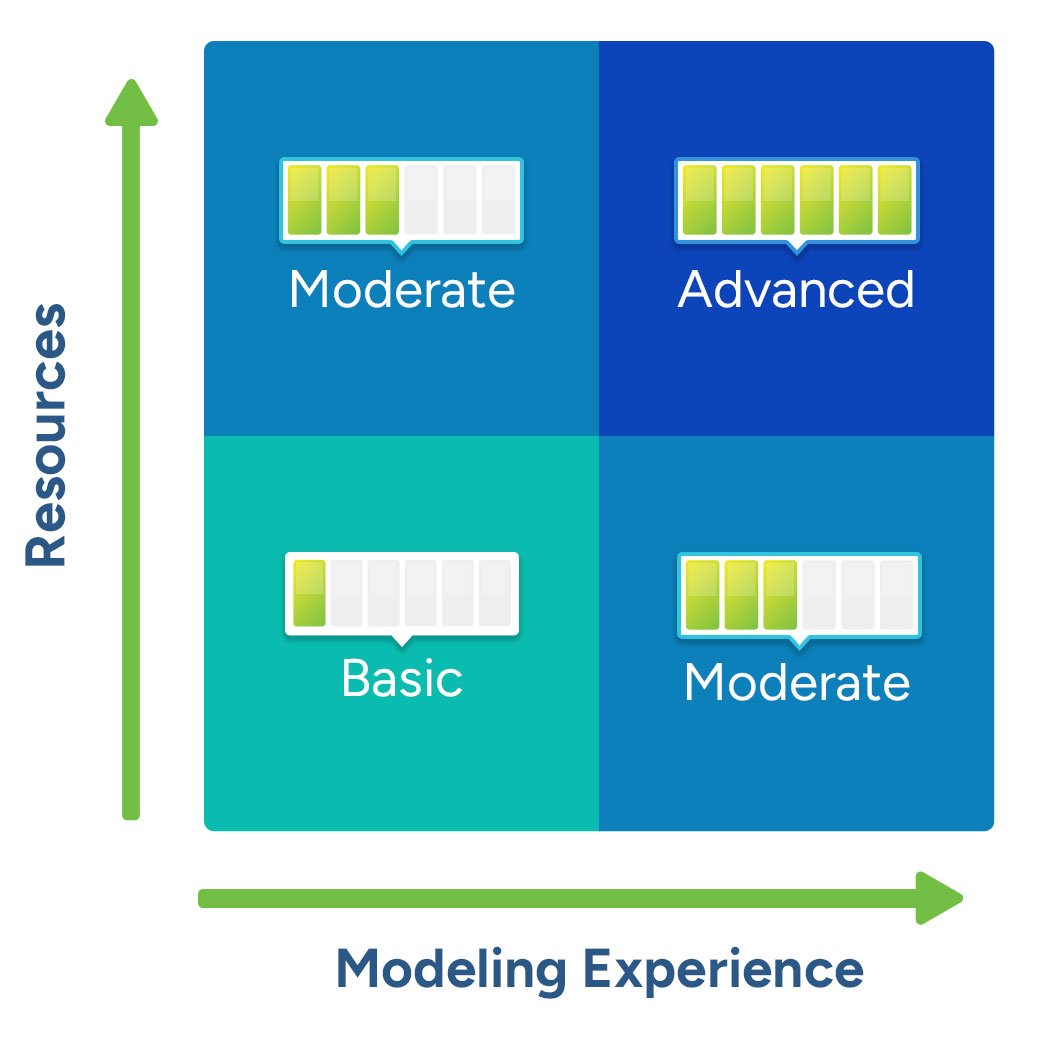
Setting expectations is about matching ambition to capacity. Modelers must be honest about available staff, skill levels, and decision timelines. A lean, functional model that works today will always provide more value than a sprawling one that’s never finished.
Instead of perfection, aim for progression. Start small — build a “minimum viable model,” test it with leadership, and expand based on what’s actually used. This approach reframes resource constraints not as barriers, but as guardrails that keep modeling practical and maintainable.
Section 3
Simplify Early & Iterate
Complexity is seductive. It feels like rigor — but in modeling, complexity often conceals misunderstanding.
One of the biggest traps we saw in Module 4 was overbuilding: teams layering data, formulas, and “what-ifs” far beyond what leadership actually needs. The result? Models that are impressive in scope but impossible to explain, maintain, or trust.
The most effective models start simple — built around a minimum viable model that captures only what’s essential to answer the immediate question. Overbuilding early often creates complexity that’s hard to unwind later. Simplification is not about dumbing down the analysis; it’s about focusing on what drives outcomes. The best models strip away noise and make the relationships between assumptions and results obvious.
Iteration is what gives simplification its power. Each modeling cycle — whether annual, quarterly, or project-based — provides new data and insights that refine the structure. Rather than building the “perfect” model all at once, teams should approach it as a living framework: expand when value is proven, streamline when relevance fades. This disciplined evolution ensures models grow smarter, not just larger.
A clear model lets you see the mechanics of cause and effect. If enrollment shifts, tuition changes. If rates rise, reserves adjust. The fewer unnecessary calculations between those points, the faster and clearer the insights.
To simplify effectively:
Start with the question, not the data.
Include only what serves the decision at hand.
Build from outputs backward.
Identify the reports or KPIs decision-makers need, then structure inputs accordingly.
Avoid false precision.
Forecasting to the penny doesn’t make your model smarter; it just makes it slower.
Model the rule, not the exception.
Outliers can be analyzed separately; they shouldn’t dictate structure.
Simplicity supports accountability. It makes models explainable — to boards, to regulators, and to the public. When anyone can trace how a single assumption leads to a projected outcome, trust follows.
Section 4
Design Around Use
A model that can’t adapt to change quickly loses relevance. Budgets evolve, funding priorities shift, and leadership cycles bring new questions. The models that endure aren’t the ones that capture every detail — they’re the ones built to change gracefully.
Designing around use means anticipating the life of the model beyond its creation. A well-structured model should invite interaction, not fear of breaking something.
Separate assumptions from formulas so updates can be made safely. Use inputs, toggles, and linked drivers that let users explore scenarios without editing the core logic. When design mirrors real decision flows — for instance, letting a user adjust rates, headcount, or capital timing directly — the model becomes an instrument for insight, not maintenance.
For public-sector teams, adaptability is more than convenience; it’s survival. Grant cycles end, regulations evolve, and cost structures shift under inflationary pressure. A rigid model forces rebuilds, but a modular one scales forward — new mandates or funding sources can slot in without upending what came before.
Design around use also extends to communication. A model built for engagement should translate easily into visuals and reports. When outputs are structured around stakeholder needs — a board summary, a rate study, or a grant performance view — the model supports faster, clearer decisions.
Section 5
Create Institutional Memory
A model that only one person understands isn’t a model — it’s a vulnerability. Public institutions depend on continuity, yet many lose institutional knowledge faster than they can capture it.
Creating institutional memory means embedding knowledge into both the system and the culture. A strong model documents its own logic — every assumption traceable, every outcome explainable.
It lives where multiple people can access, test, and refine it, rather than sitting in a private folder or personal drive. Just as importantly, it invites collaboration: finance officers, analysts, and department leads all working from a shared source of truth.
Institutional memory is what transforms a financial model from a temporary project into an enduring decision framework. It protects not only the data, but the thinking behind it — ensuring that insight survives leadership changes, funding cycles, and technology shifts alike. In the public sector, that continuity isn’t just convenient; it’s an obligation. A transparent, shared model builds trust within the organization and confidence within the community it serves.
Section 6
Collective Principle
Across all these guidelines, a single truth remains:
Perfection is the enemy of progress.
Financial models are never “finished.” They evolve. Chasing flawless precision or completeness leads to paralysis; focusing on structure, purpose, and usability leads to insight.
Each principle — setting goals, calibrating expectations, simplifying structure, designing for change, and preserving knowledge — builds toward the same outcome: a modeling culture that prioritizes clarity and continuity over complexity and ego. The goal isn’t to build the perfect model; it’s to build a model that consistently helps your institution. make better, faster, and more transparent decisions.

Learning Objectives Recap
By the end of this module, you should be able to:
Identify the core principles that define sustainable, adaptable financial modeling frameworks for public and nonprofit organizations.
Connect each principle to a common modeling challenge — understanding how clear goals, simplicity, and flexibility counteract confusion, fragility, and overcomplexity.
Apply these principles when structuring or assessing your own model, ensuring it remains focused on decision-making, adaptable to change, and sustainable over time.
Quick Quiz
Test Your Knowledge
- A) Design around use
- B) Simplify early and iterate
- C) Set expectations
B) Simplify early and iterate
- A) Create institutional memory
- B) Set expectations
- C) Design around use
A) Create institutional memory
- A) Data overload
- B) Scope creep
- C) Resource scarcity
B) Scope creep
Wrap Up
The Synario Advantage
The principles above define what effective modeling should achieve—clarity, focus, adaptability, and continuity. Synario puts those principles into practice:
- Set Goals: A scenario-first framework aligns every assumption to a decision, so models start with purpose and stay tethered to it.
- Set Expectations: Right-sized build paths (prototype → expand) help teams deliver quick wins and scale only where value is proven—no need to overbuild on day one.
- Simplify & Iterate: Object-based structure reduces redundancy and lets teams refine over time—add what matters, retire what doesn’t, without rebuilds.
- Design Around Use: Clear separation of drivers and logic, with modular components, makes updates safe and change-ready as mandates, funding, or policies shift.
- Create Institutional Memory: Shared access and transparent lineage preserve the “why” behind results, so insight survives staff turnover and leadership changes.
Together, these capabilities turn modeling from a maintenance task into a decision discipline—helping public-sector teams plan with clarity, adapt with confidence, and communicate with credibility.
Next Step
Continue to M101-6: Major Model Elements
With the guiding principles established, the next module dives into the structural components that bring these ideas to life: data, assumptions, logic, and outputs, all working together to deliver clarity from complexity.