

Financial modeling sits at the heart of decision-making for institutions facing unpredictable futures.
Annual budgets offer a one-year snapshot — enough for immediate needs, but not for understanding the road ahead. Financial models, by contrast, stretch the horizon to five, even ten years, revealing how today’s choices shape tomorrow’s outcomes.
Across public and nonprofit sectors, the stakes are real.
%201.svg)
Higher education
is navigating enrollment cliffs and tuition volatility.

Governments
face unpredictable state and federal funding.

Utilities
must modernize aging infrastructure while keeping services affordable.
These aren’t abstract challenges — they’re the forces that determine whether institutions can adapt or fall behind. Without a model, leaders rely on intuition and fragmented data. With one, they gain a structured way to test strategies before committing, replacing intuition with structured, data-driven insights.
Learning Objectives Recap
After completing this introduction, you should be able to:

Articulate the goals of financial modeling
Understand how inputs and outputs are connected in a model.
Recognize why modeling is essential for an organization’s finance leaders.
Wrap-Up
The Synario Perspective
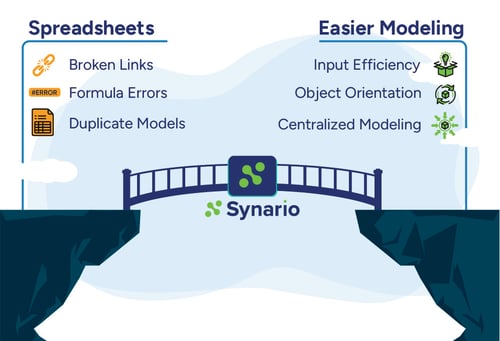 Traditional spreadsheets give finance teams flexibility — but that flexibility comes at a cost. To test multiple scenarios, teams often build duplicate models, patch formulas, or rely on fragile links between workbooks. As complexity grows, so does the likelihood of error, versioning issues, and time spent on maintenance instead of insight.
Synario was built to eliminate that tradeoff. Instead of choosing between speed and accuracy, finance teams can have both. Its scenario-first structure allows for instant toggling between assumptions, clear auditability of logic, and rapid visualization of outcomes. That means less time fixing broken links and more time engaging in the strategic conversations that move organizations forward.