
Section 2
A Model Defined
At its core, a financial model is a tool for exploring possible futures. It combines what we know with what we can reasonably project, allowing decision-makers to anticipate outcomes and understand trade-offs. In a higher education context, a model might project net tuition revenue across different enrollment and discount scenarios. For a public utility, it might examine how regulatory shifts impact capital plan requirements or how rate adjustments ripple through a long-term financial forecast.
The power of a model isn’t in the numbers themselves, but in the relationships between them — how a change in one assumption can reshape the entire financial picture. A good model makes those relationships clear, so leaders can see the impact of their decisions before they make them.

Section 3
Essential Elements of a Model
Every effective model, regardless of industry or format, shares four building blocks:
1. DATA
Historical data grounds the model in reality. It’s the foundation that gives credibility to every projection. For example, operating revenues, expenses, enrollment numbers, or usage data show where you’ve been, allowing the model to anchor forecasts in real performance. Reliable data collection and consistency are what ensure the model starts with truth before extending into the future.
2. ASSUMPTIONS
Assumptions turn static data into dynamic forecasts — they reflect the conditions or expectations that might change, such as tuition or utility rates, grant funding, or inflation. These serve as levers leaders can pull to explore how small policy or market shifts ripple through an organization’s financial health.
3. STRUCTURE
The structure is the wiring that connects everything. It’s the formulas, relationships, and hierarchy that determine how assumptions affect outcomes. In strong models, structure mirrors how an organization actually operates — departments roll into divisions, projects connect to funding, and each piece responds predictably when conditions change. Weak structure, by contrast, creates opacity and fragility.
4. OUTPUTS
Reports and charts bring a model to life by combining all of these elements into a cohesive, forward-looking view. These provide the lens needed to understand how outcomes unfold across time. These outputs are then tested and refined through iteratively through different assumptions — showing how each change influences long-term results. Ultimately, this model reveals the organization’s financial story through reports, charts, and key performance indicators (KPIs), turning raw data into foresight.
The Anatomy of a Financial Model
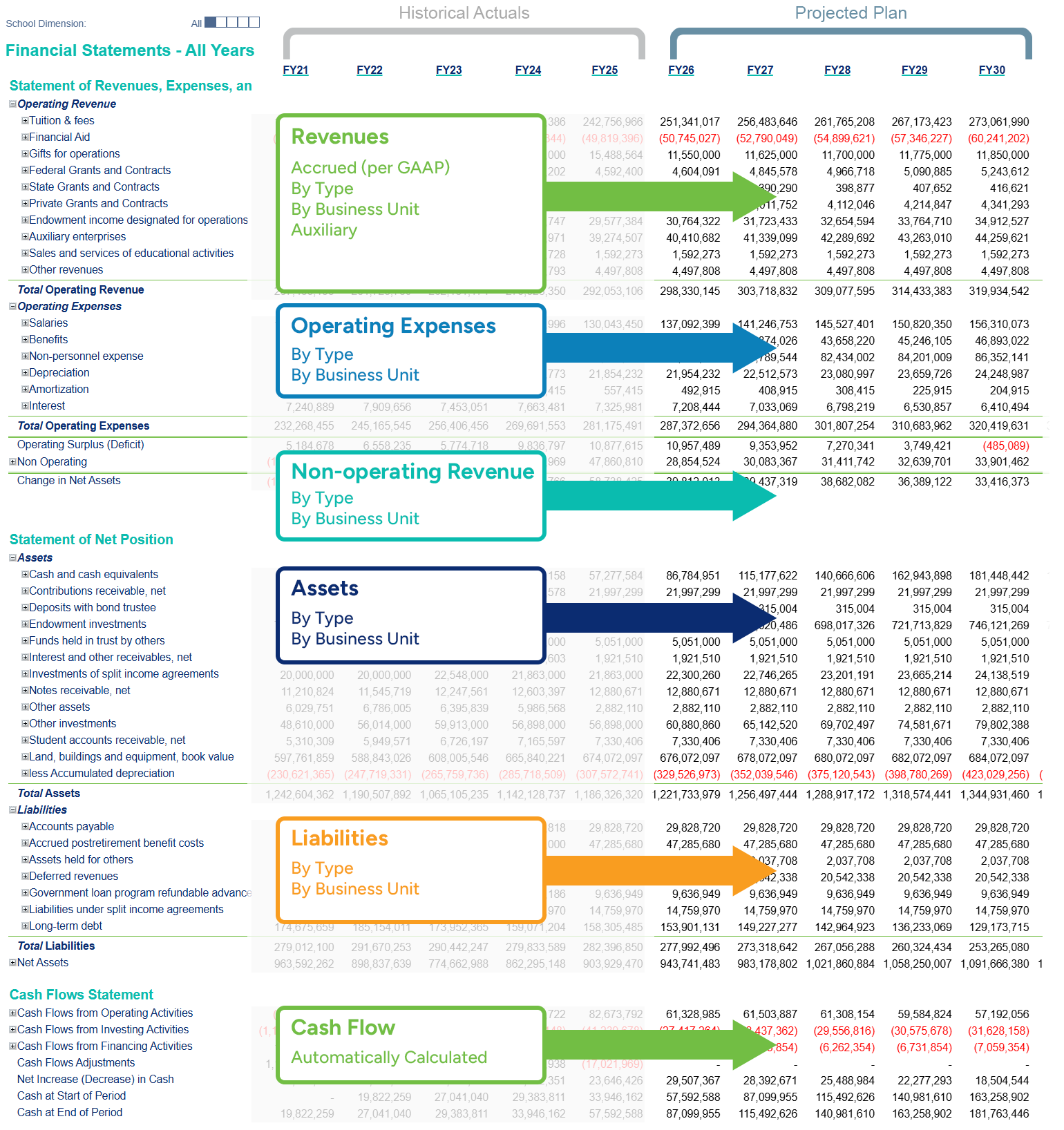
Together, these elements form the foundation of an effective model. Data provides context, assumptions introduce flexibility, structure mimics the way your institution functions, and outputs allow you and others to understand impacts of decisions. When they’re integrated properly, they turn a simple spreadsheet into a living system that helps institutions navigate uncertainty with confidence. These components ensure public leaders can trace every forecast back to a clear, defensible logic.
Section 5
The Spreadsheet Reality
Most models start in spreadsheets, and for good reason: they’re flexible, familiar, and accessible. But the very flexibility that makes them useful also makes them fragile. Complex models quickly grow into labyrinths of linked tabs, nested formulas, and delicate dependencies. A single broken reference can ripple across a forecast, undermining confidence in its accuracy.
Version control becomes a challenge, too. Different users make changes, test scenarios in separate copies, or layer in their own assumptions. Before long, no one is entirely sure which version of the model is the truth. When dozens of departments or funds contribute, version confusion and audit risk multiply—undermining confidence across oversight bodies. These limitations don’t make spreadsheets bad — they just make them ill-suited to the kind of fast, transparent, and collaborative modeling modern finance requires.

Learning Objectives Recap
By completing this module, you should be able to:

Define the structure and purpose of a financial model within public sector operations.
Identify how core model elements apply to mission-driven institutions.
Explain how structured modeling strengthens governance and public trust.
Wrap-Up
The Synario Advantage
Synario simplifies public financial modeling by linking every assumption—tuition, rate, or funding change—to the entire institutional model. Universities, utilities, and local governments can instantly visualize the impact of new policies, capital projects, or rate structures. What once required multiple spreadsheets becomes a transparent, auditable model built for collaborative decision-making.
Where spreadsheets introduce fragility, Synario builds resilience. It brings structure to scenario planning and clarity to financial conversations, ensuring that when decisions are made, they’re made with confidence.