
M101: Why Financial Modeling Matters in Public & Nonprofit Finance
5m Read
Financial modeling sits at the heart of decision-making for institutions facing unpredictable futures.
Annual budgets offer a one-year snapshot — enough for immediate needs, but not for understanding the road ahead. Financial models, by contrast, stretch the horizon to five, even ten years, revealing how today’s choices shape tomorrow’s outcomes.
Across public and nonprofit sectors, the stakes are real.
Higher education
is navigating enrollment cliffs and tuition volatility.
Governments
face unpredictable state and federal funding.
Utilities
must modernize aging infrastructure while keeping services affordable.
These aren’t abstract challenges — they’re the forces that determine whether institutions can adapt or fall behind. Without a model, leaders rely on intuition and fragmented data. With one, they gain a structured way to test strategies before committing, replacing intuition with structured, data-driven insights.
Section 1
Modeling for the Public Sector
A model exists to connect inputs to outputs in a structured, explainable way.
INPUTS
The conditions and assumptions that describe current conditions and potential changes that drive projections.
OUTPUTS
The forecasts, projections, and insights that flow from those assumptions.
Between these two halves sits the logic — the structure that transforms raw information into decision-ready intelligence. Budgets are built to balance a single year. Models are built to understand and shape the years ahead.
For example:
In higher education, a model might translate tuition pricing, enrollment shifts, and aid policies into clear financial implications.
For governments, models help anticipate and smooth revenue volatility before it disrupts essential services.
For utilities, models clarify how capital projects and funding timelines impact long-term ratepayer affordability.
But modeling isn’t just about understanding assumptions — it’s about changing them and exploring what happens next. A university might ask, “What if enrollment drops by 10%?” A utility might test how a delayed grant affects cash flow. This kind of scenario testing lets organizations explore multiple futures side by side, making uncertainty something they can plan for, not fear. This isn’t about predicting the future with precision. It’s about giving leadership a decision-making framework — a way to adapt quickly, allocate resources effectively, and communicate their strategy with confidence.
As finance leaders test different assumptions, models must be updated repeatedly to reflect new conditions. How efficiently a model can absorb these changes—and present them clearly—has a direct impact on how quickly and confidently leaders can make decisions.
Learning Objectives Recap
After completing this introduction, you should be able to:
Articulate the goals of financial modeling
Understand how inputs and outputs are connected in a model.
Recognize why modeling is essential for an organization’s finance leaders.
Quick Quiz
Test Your Knowledge
- A) To comply with financial reporting requirements
- B) To replace intuition with structured, data-driven insights
- C) To create static annual budgets
B) To replace intuition with structured, data-driven insights
- A) It provides a structured framework to test strategies, adapt to change, and communicate decisions with confidence.
- B) It ensures leadership can predict the future with precision.
- C) It focuses leaders only on meeting short-term budget goals.
A) It provides a structured framework to test strategies, adapt to change, and communicate decisions with confidence.
- A) Budgets look further into the future
- B) Models focus only on operational details
- C) Models offer long-term visibility and adaptability
C) Models offer long-term visibility and adaptability
Wrap-Up
The Synario Perspective
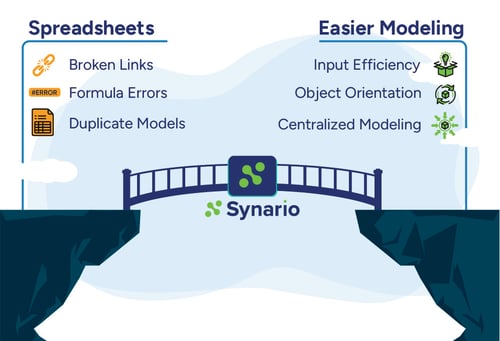
Traditional spreadsheets give finance teams flexibility — but that flexibility comes at a cost. To test multiple scenarios, teams often build duplicate models, patch formulas, or rely on fragile links between workbooks. As complexity grows, so does the likelihood of error, versioning issues, and time spent on maintenance instead of insight.
Synario was built to eliminate that tradeoff. Instead of choosing between speed and accuracy, finance teams can have both. Its scenario-first structure allows for instant toggling between assumptions, clear auditability of logic, and rapid visualization of outcomes. That means less time fixing broken links and more time engaging in the strategic conversations that move organizations forward.
Next Step
Continue to M101-2: What’s a Model
Learn how these foundational principles take shape inside a structured modeling framework.