

M101-3: The Case for Modeling
7m Read
Public and nonprofit institutions rarely succeed because they can predict the future perfectly. They succeed because they can anticipate change, adapt strategies, and plan transparently.
Financial modeling gives these institutions the ability to translate uncertainty into structured foresight—helping public finance leaders understand their trajectory, manage risk, and align stakeholders around informed decisions. Whether it’s a university preparing for enrollment fluctuations, a utility navigating new regulations, or a local government balancing limited funds, modeling transforms complexity into clarity.
Section 1
Understand Your Current Trajectory
A financial model helps leaders answer a deceptively simple question: If nothing changes, where are we headed?
1. Take a Longer-Term View
Budgets describe a single year, but models reveal the slope of performance over time—showing whether today’s path is sustainable.
- In higher education, modeling helps institutions forecast things like net tuition revenue against projected enrollment and discount rates, clarifying when tuition dependence or declining enrollment could destabilize the operating budget.
- In utilities, it shows how long-term infrastructure investments affect rate stability and cash reserves.
- In government, it can highlight how rising personnel costs or expiring grant funding affect the sustainability of core services and programs over multiple budget cycles.
2. Assess Whether the Current Plan Is Working
Modeling turns a financial plan into a testable hypothesis. By comparing projected outcomes to actual results, leaders can see whether performance aligns with strategy.
This process transforms financial management into continuous learning. When assumptions deviate from reality, models make those deviations visible, prompting timely adjustments and sharper future forecasts. In this way, modeling establishes a feedback loop between planning and execution — one that builds organizational discipline and data-driven accountability over time.
3. Establish a Point of Comparison
Every analysis needs a reference point — a baseline scenario that defines “business as usual.” The baseline becomes the control group against which all other scenarios are tested. Once that baseline is clear, alternate scenarios can be layered on to test new policies, pricing strategies, or funding approaches.
This practice doesn’t just illustrate what might happen — it clarifies why differences occur. By isolating the effects of each decision variable, modeling helps leaders distinguish between external pressures and internal choices, focusing attention where it matters most.
Section 2
Identify and Mitigate Risks
No organization is immune to risk — but not all institutions see risk early enough to act. Modeling allows finance teams to stress-test assumptions and build strategies for disruption before it happens.
MARKET RISK arises from shifts in the external environment—economic changes, demographic trends, or fluctuating demand. For higher education, this might mean declining enrollment or tightening state appropriations; for utilities, it could involve unexpected drops in usage or new regional competitors. Modeling helps quantify how these shifts impact long-term revenues, reserves, and service affordability.
STRATEGIC RISK arises when an organization’s goals or assumptions no longer align with changing realities. It develops gradually as funding patterns, stakeholder needs, or external conditions evolve faster than the strategies meant to guide them. When this misalignment goes unaddressed, it can erode financial resilience and undermine mission progress.
OPERATIONAL RISK stems from failures within internal systems, processes, or infrastructure. Deferred maintenance, staffing shortages, and technology failures all carry financial consequences that traditional budgets often conceal. Modeling these risks enables organizations to measure potential costs, test contingency plans, and evaluate the impact of preventive investment.
COMPLIANCE & REGULATORY RISK involves exposure to changing legal or oversight requirements. A utility might face evolving environmental mandates like PFAS mitigation, while a university might navigate new changes to federal loan programs or accreditation. Modeling these shifts helps leaders assess the financial implications of compliance, ensuring that transparency doesn’t come at the expense of sustainability.
WORKFORCE RISK reflects pressures on labor, benefits, and institutional knowledge. In many public institutions, a large portion of senior leadership is nearing retirement age—meaning decades of experience, historical context, and decision logic are at risk of leaving these institutions. Modeling helps quantify the operational and financial effects of that transition, revealing how leadership turnover may influence institutional continuity and capacity.
Beyond succession challenges, rising pension obligations, competitive hiring markets, and evolving workforce expectations continue to strain budgets. By modeling compensation adjustments, staffing levels, and succession timelines, leaders can test how personnel decisions affect affordability, institutional stability, and service quality over time.
Ultimately, modeling doesn’t eliminate risk—but it transforms it from uncertainty into insight. By quantifying potential disruptions and visualizing their long-term impact, public institutions can plan proactively, build resilience, and make confident decisions when conditions change.
Section 3
Identify and Capitalize on Opportunities
While risk often motivates modeling, opportunity is what sustains it. Once leaders understand their institution’s current trajectory, the next step is identifying where growth, efficiency, or innovation can occur. In the public sector, this means finding ways to strengthen mission delivery while preserving financial stability. Financial modeling helps institutions test possibilities, not just problems—it becomes a laboratory for strategic thinking, revealing what’s possible before resources are committed.
Pricing decisions shape the financial health of every organization, yet too often, they’re driven by short-term pressures or outdated assumptions. Modeling allows leadership to test how even small changes in rate or tuition structures ripple through long-term outcomes. It exposes the trade-offs between affordability, revenue stability, and strategic investment—showing how each adjustment influences both financial sustainability and community trust. Over time, this approach helps institutions establish pricing strategies rooted in evidence rather than reaction, aligning financial necessity with mission integrity.
Exploring new lines of service or delivery is one of the most powerful ways modeling turns vision into opportunity. By testing potential initiatives before they’re implemented, leaders can identify where innovation creates the greatest impact—and where timing or scale may need refinement. Modeling enables leadership to assess feasibility, resource needs, and long-term value early in the process, transforming creative ideas into actionable strategies. Whether it’s evaluating new revenue streams, community programs, or operational models, this type of analysis reveals how each opportunity strengthens the institution’s mission and financial resilience.
Ultimately, opportunity modeling isn’t about chasing every idea; it’s about using data to prioritize the ideas that matter most. By testing strategies in a safe, simulated environment, public finance leaders can focus energy where it creates the greatest mission and community impact—ensuring that every initiative advances both financial and public value.
Section 4
Inform Strategy and Decision-Making
In public finance, effective decision-making depends on seeing the full picture — not just a single-year budget snapshot. Financial models bridge that gap by translating complex financial relationships into actionable insight.
Modeling allows leaders to test alternative strategies, compare timing, and measure trade-offs across multiple dimensions. By layering scenarios, they can understand how short-term choices affect long-term stability, how capital priorities influence operating flexibility, and how resource allocation supports institutional goals.
Just as importantly, modeling connects strategy to tactics. It turns broad institutional goals — such as financial sustainability or equity in service delivery — into specific, testable actions. When leaders can evaluate multiple scenarios side by side, they move beyond “best guess” planning to evidence-based prioritization.

Section 5
Communicate and Align Stakeholders
Even the most accurate financial model has a limited impact if its insights aren’t understood or trusted. Modeling’s greatest value emerges when it helps people see the logic behind decisions. For public and nonprofit institutions, that means transforming complex projections into clear, persuasive narratives that build alignment among boards, councils, and communities.
Effective models don’t just calculate — they communicate. Visual dashboards, side-by-side scenario comparisons, and affordability charts help translate financial outcomes into terms that resonate with non-financial audiences. When stakeholders can trace assumptions and understand the “why” behind every outcome, trust grows, and collaboration becomes easier.
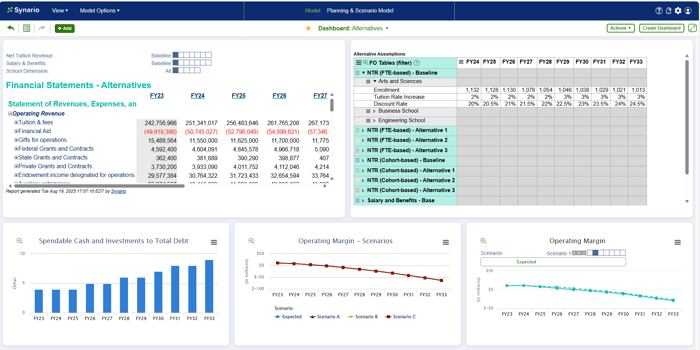
Creating that narrative is the bridge between analysis and action. A well-told financial story connects the numbers to purpose—explaining not only what the data shows, but what it means for the institution’s future. It turns projections into possibilities, helping leaders envision the change they need to champion.
This transparency is especially critical in the public sector, where every decision carries community impact. Modeling provides a framework for data-driven storytelling — showing how each decision supports long-term fiscal stewardship, service reliability, and mission integrity.
Learning Objectives Recap
By the end of this module, you should be able to:
Explain how modeling helps public and nonprofit institutions plan strategically amid uncertainty.
Identify how models reveal trajectory, opportunity, and risk.
Describe how modeling fosters transparency and stakeholder alignment in public finance.
Quick Quiz
Test Your Knowledge
- A) Maximizing year-over-year revenue growth
- B) Supporting long-term service sustainability
- C) Reducing community involvement
- D) Limiting scenario analysis
B) Supporting long-term service sustainability
- A) True
- B) False
A) True
- A) Hide assumptions
- B) Delay decisions
- C) Build trust through transparent analysis
- D) Eliminate oversight
C) Build trust through transparent analysis
Wrap Up
The Synario Advantage
Traditional spreadsheets can’t scale to the complexity of public finance, where every tuition policy, rate change, or grant decision affects multiple stakeholders— not without friction. Each scenario often requires duplicate files, manual updates, and fragile formulas that make transparency difficult. When the conversation moves from finance to leadership, those limitations can quickly erode confidence.
Synario was designed to make this process fast, flexible, and transparent. Scenario-first modeling, structured assumptions, and dynamic outputs allow finance teams to show — not just tell — what different strategies mean for the organization. Whether the conversation is about opportunity, risk, or strategic direction, Synario turns the model into a trusted decision-making platform.
Next Step
Continue to M101-4: The Challenges of Modeling
Explore why spreadsheet-based models often fail to deliver this level of insight — and how to overcome those obstacles.