

Section 1
Why Analysis Is More Than Recalculation
A financial model is not built simply to project one outcome. Its primary value lies in analysis: the ability to explore how results change when conditions, assumptions, or strategic decisions evolve.
Projection describes the expected path forward. Analysis tests how that path changes when assumptions shift.
Through analysis, finance teams establish a baseline projection and then test how that baseline responds to alternative assumptions, emerging risks, and strategic initiatives. Assumptions can be recast to reflect changing economic conditions. Projects or initiatives outside the current operating state can be introduced. Different combinations of assumptions and initiatives can be activated and compared. Outcomes can be evaluated side by side to assess affordability, sustainability, and risk exposure.
In higher education, utilities, and municipal governments, this often means confronting questions such as:
- What happens if enrollment declines over several years instead of stabilizing?
- Can we afford higher wage growth without eroding operating margins?
- What is the fiscal impact of implementing a hiring freeze?
- How does a new capital project affect long-term debt capacity or rate stability?
- What changes if projects under consideration are delayed, phased, or canceled?
These are not spreadsheet exercises, they are governance questions. They shape board decisions, capital planning, workforce strategy, rate-setting, and long-term sustainability.
The challenge is rarely conceptual. Finance leaders understand the questions they need answered. The difficulty lies in how analysis is structured inside the model. If testing alternatives requires rewriting formulas, duplicating files, or increasing structural complexity, the cost of exploration rises. Over time, the model becomes heavier with each new question.
Analysis is a structural capability. The architecture of the model determines whether alternatives can be explored fluidly or whether each new scenario adds fragility.
Section 2
Traditional Analysis in Spreadsheet Models
In spreadsheet environments, analysis typically follows a predictable pattern. A baseline projection is established first, representing current assumptions and expected outcomes. From there, users modify assumptions to reflect alternative conditions, introduce projects or initiatives, and compare the resulting outputs to the original baseline.
Conceptually, the process is straightforward:
- Establish a baseline.
- Modify assumptions to reflect an alternative.
- Introduce projects or initiatives.
- Compare the results.
The difficulty does not lie in the analytical logic. It lies in how spreadsheets structurally manage assumptions and formulas.
At the most basic level, a spreadsheet cell can contain only one thing at a time: a value or a formula. It cannot simultaneously hold both a baseline assumption and an alternative version of that assumption. It cannot preserve multiple calculation methodologies within the same structural location without additional engineering.
This constraint forces users into two primary approaches, each workable, but structurally costly.
Option 1: Destructive Modeling
The simplest approach is to overwrite assumptions directly. Headcount values are changed. Salary growth rates are adjusted. Benefits assumptions are modified. Capital expenditures are added manually to the projection rows.
This approach is easy to execute, but it is destructive by design. When assumptions are overwritten, the original values are lost. Prior results cannot be recalled without re-entering data. Baseline comparisons become difficult unless they have been captured elsewhere.
To preserve prior versions, teams often create duplicate copies of the model. Each file represents a different scenario. While this protects the original assumptions, it introduces new structural challenges. Multiple files must be managed and maintained. Logic changes must be replicated consistently across every version. Comparisons require reconciliation across disconnected spreadsheets. If structural updates occur, data may need to be rebuilt in several places.
As versions multiply, maintenance effort grows. The model expands not in analytical depth, but in file count and administrative overhead.
Option 2: Advanced Conditional Modeling
A more sophisticated approach attempts to avoid overwriting by storing alternative assumptions within the same spreadsheet. Boolean logic, nested IF statements, scenario flags, and occasionally macros are used to dynamically select between baseline and alternative values.
Rather than replacing assumptions, additional rows or columns are created to house alternatives. Formulas are written to determine which values should apply under a given scenario.
This approach preserves prior assumptions and avoids duplicating entire models. However, it introduces a different form of structural complexity.
Formulas grow longer and more difficult to audit. Each new alternative requires additional structural space. Scenario flags must be wired throughout every affected calculation area. As the number of scenarios increases, so does the density of conditional logic embedded across the model.
The model grows not just in size, but in logical interdependence. Each additional scenario introduces more rows, more nested IF statements, and more dependency paths. Performance may slow. Auditability declines. Model understanding often concentrates with the original architect who understands how scenario flags propagate through formulas.
Analysis remains possible, but structural weight increases with every alternative introduced.
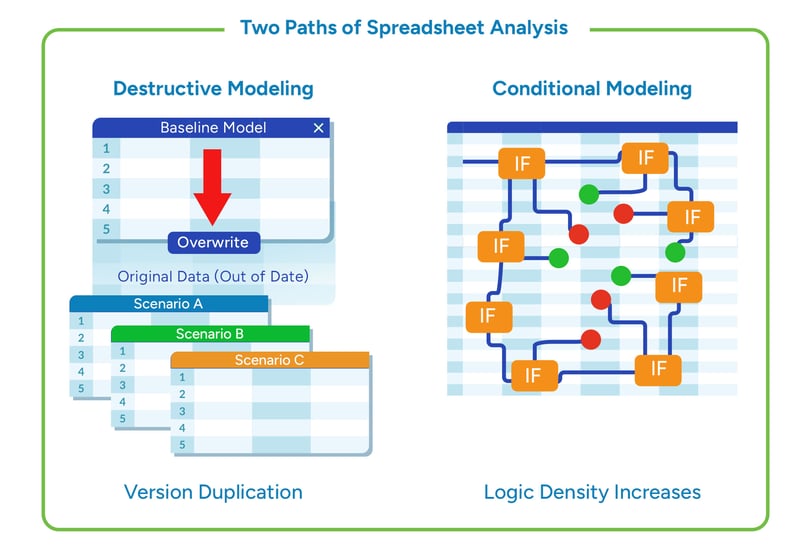
Over time, both approaches reveal the same underlying constraint: the architecture of the spreadsheet intertwines assumptions, logic, and scenario selection. Each new question adds structural burden. Flexibility and simplicity begin to compete.
Section 3
Projects and Initiatives: A Structural Challenge
Capital projects and strategic initiatives introduce a different kind of analytical stress. While assumption changes adjust existing behavior, projects often introduce entirely new financial activity, such as new costs, new revenues, new debt, new staffing, or new operating dynamics.
Most spreadsheet models are designed around the current state of operations. Their structure reflects existing departments, programs, revenue streams, and cost categories. When a proposed initiative falls outside that structure — such as a new academic program, a major infrastructure investment, a service expansion, or a workforce restructuring - integrating its impact can require structural modification.
In practice, this often means creating new tabs, reorganizing data, adding supplemental calculation blocks, or performing what feels like structural “surgery” to connect the initiative to the broader financial statements. The model must be altered to accommodate something it was not originally designed to contain.
Alternatively, teams may analyze projects separately and merge the results into the institutional model afterward. While expedient, this approach introduces its own risks. Dynamic dependencies can be broken when the project analysis is disconnected from the main model. Assumptions that should interact, such as debt capacity, staffing levels, or operating margins, may not update automatically. Re-running the analysis becomes cumbersome because changes must be replicated in multiple places. When results are rolled up institution-wide, inconsistencies can emerge between integrated and externally calculated components.
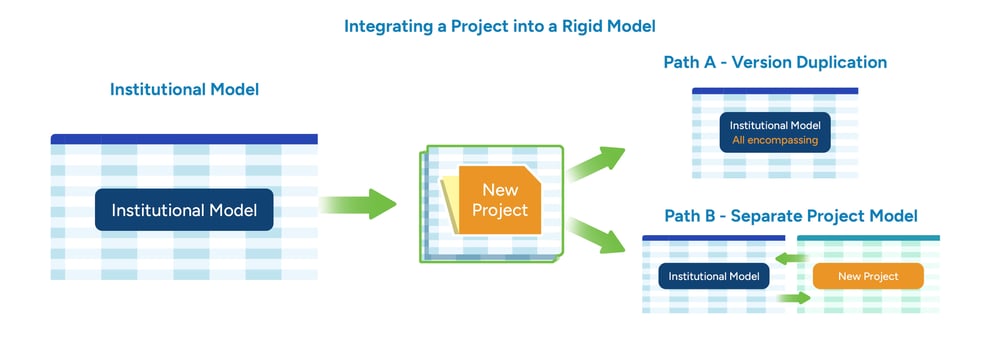
Projects are also rarely static. They move between “under consideration,” “approved,” “phased,” “delayed,” or “canceled.” Governance often requires evaluating multiple combinations: What if this project proceeds but that one does not? What if both move forward? What if neither does?
Enabling true on/off functionality in spreadsheet environments typically requires advanced modeling architecture and careful discipline in how assumptions are structured. Without that architectural foresight, models become rigid. Each additional initiative increases structural complexity, and flexibility decreases precisely when decision-makers require adaptability most.
Projects do not merely add numbers to a model. They test the model’s architecture. If incorporating change requires structural modification each time, analytical exploration becomes increasingly costly.
Section 4
Comparing Results in Spreadsheets
Once alternatives have been generated, comparison introduces another layer of effort. Producing two or three scenarios is only part of the analytical task; decision-makers must also see how those outcomes differ in meaningful ways.
In spreadsheet environments, comparison often requires building additional structures. Summary comparison tabs may be created to align baseline and alternative outputs side by side. New reports may be constructed to highlight deltas. Outputs are frequently copied into presentation files, where results are manually organized for board or council review. In some cases, differences must be reconciled manually to ensure totals align across scenarios.
If multiple spreadsheet versions are used, as in destructive modeling approaches, comparison becomes even more fragmented. Results may live in separate files. Structural updates may not be synchronized. Logic adjustments made in one version may not be reflected in another. Before comparisons can even begin, consistency must be verified.
As alternatives accumulate, the structural burden increases. Each new scenario requires additional comparison tables, expanded summary sheets, or replicated reporting structures. The practical number of manageable scenarios becomes finite, not because the questions are limited, but because the structural overhead of maintaining them grows.
Over time, analysis may produce:
- A limited set of carefully maintained scenarios
- Increasing structural complexity within the model
- Growing dependence on the individual who understands how comparisons were constructed
- Elevated risk of subtle logic inconsistencies
The analysis itself is possible, often impressively so. But each additional comparison adds weight to the model’s structure. Without architectural separation between baseline, alternatives, and reporting views, exploration becomes progressively more costly to maintain.
Section 5
Layered Modeling: Separating Structure from Variation
Traditional spreadsheet models intertwine structure and analysis. Assumptions live directly inside formulas. Alternative scenarios are embedded through conditional logic. Projects are inserted by modifying calculation blocks. As more alternatives are introduced, structural complexity increases alongside them.
Layered modeling approaches analysis differently.
Rather than overwriting assumptions or embedding selection logic throughout the model, layered modeling separates the core architecture of the model from the variations being tested. Each financial element can have multiple coexisting versions, baselines, and alternatives, without replacing one another.
A layer may represent:
- An alternative assumption (e.g., 3% wage growth vs. 4%)
- An alternative data set (e.g., revised enrollment forecast)
- An alternative calculation method (e.g., salary-only vs. total compensation)
- A project or initiative that can be included or excluded
These layers coexist simultaneously. None of them overwrites prior assumptions. None requires duplicating the model.
Analysis becomes a process of activating combinations of layers rather than rewriting formulas. The baseline remains intact. Alternatives are additive rather than destructive. Projects can be toggled without structural “surgery.”
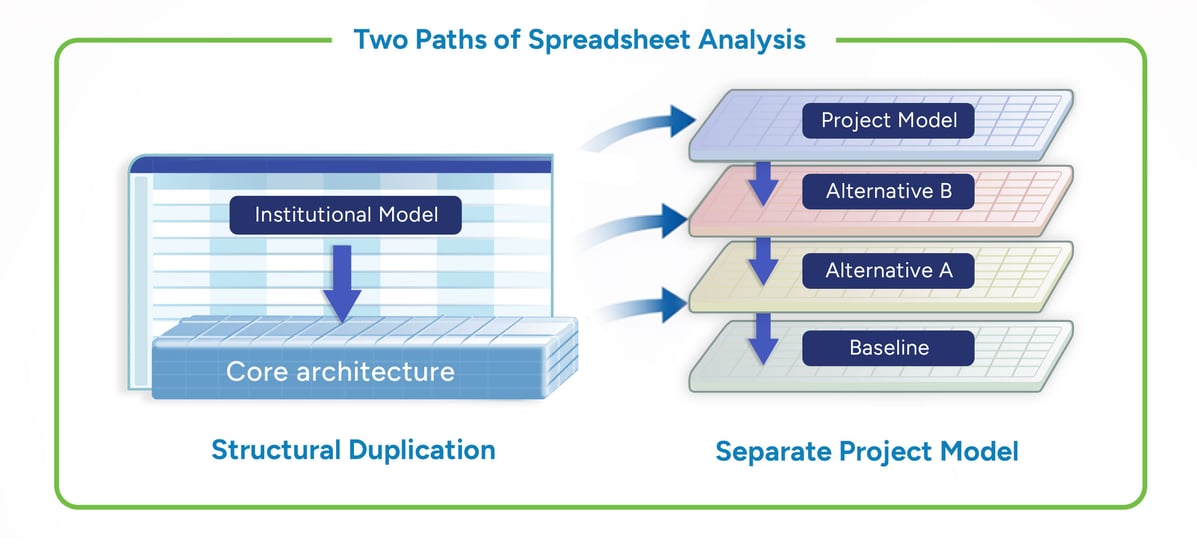
This approach is not native to traditional spreadsheet environments. Because spreadsheet cells can only contain one value or formula at a time, layered coexistence must be simulated through duplication or complex conditional logic. As a result, layered modeling represents a structural shift, separating architecture from analytical variation.
Learning Objectives Recap
By the end of this module, learners should be able to:

Describe traditional spreadsheet approaches to scenario modeling.
Explain the risks of destructive modeling and conditional logic complexity.
Identify structural challenges introduced by projects and initiatives.