


Is Your Financial Model Ready for What Comes Next?
Use this checklist to pressure-test your current approach across the seven areas that separate a traditional model from one built to support strategic decisions.
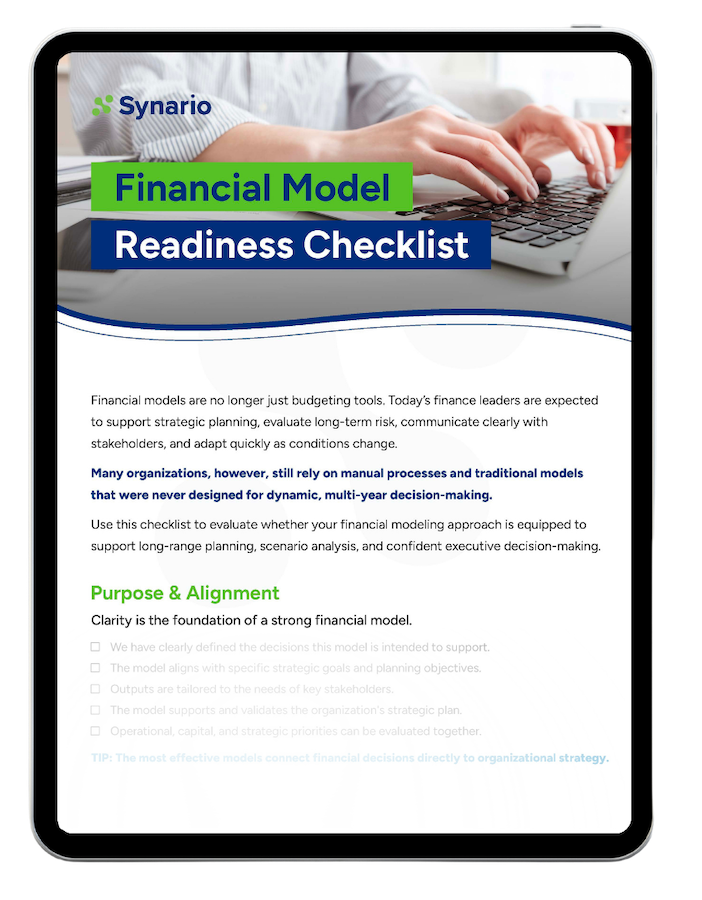
Identify the Gaps in Your Financial Modeling Process
Public finance leaders are being asked to do far more than manage the annual budget. You are expected to guide strategy, evaluate long-term risk, adapt assumptions as conditions change, and give leadership clear answers quickly. Many teams are still working from traditional models that were never built for that level of complexity. The result is often familiar: disconnected assumptions, time-consuming scenario updates, and reports that take days to prepare.
The Financial Model Readiness Checklist gives you a fast, clear view of where your current approach stands across seven critical areas, from model structure and assumptions to scenario analysis and stakeholder communication. Every box you leave unchecked points to a specific, solvable gap.
The checklist will help you assess:
- Strategic alignment
- Model structure and integrity
- Data and assumptions
- Planning horizons
- Scenario and sensitivity analysis
- Stakeholder communication
- Long-term sustainability
Complete the short form to get your checklist and see how ready your model really is for what comes next.
Understanding the Foundations of a Strong Financial Model in the Public Sector
A financial model is only as valuable as the decisions it helps support.
The seven areas in this checklist reflect the core capabilities that move an organization beyond traditional, static models toward more resilient, strategic financial planning. From scenario flexibility and multi-year forecasting to stakeholder communication and long-term sustainability, each area plays a role in building confidence in the planning process.
Here is why each one matters. Every box you leave unchecked points to one of these areas, and to a specific, solvable place to focus first.
Strategic Alignment
A model earns its value from the decisions it supports. When purpose is unclear, it drifts from the priorities it was built to inform and becomes a reporting exercise instead of a framework for weighing trade-offs.
Model Structure and Integrity
Structure determines how much a team can trust the model. Centralized drivers, accessible documentation, and clean version control let several people work in it without depending on one person's knowledge.
Data and Assumptions
Forecast quality follows input quality. When historical results and forward assumptions sit mixed together, updates get slower and riskier. Centralized assumptions show which drivers are actually moving the results.
Planning Horizons
Financial decisions rarely stay inside one budget cycle. A well-defined time structure supports multi-year forecasting and rolling cycles without rework, which matters most for capital, workforce, and debt decisions.
Scenario and Sensitivity Analysis
One forecast cannot answer the questions leadership asks. Strong models let teams recast assumptions, compare outcomes side by side, and toggle initiatives on or off without rebuilding anything.
Stakeholder Communication
A model that cannot be explained will not drive a decision. Dashboards and presentation-ready outputs move the conversation toward trade-offs instead of model mechanics, which matters for boards and rating agencies who never open the model.
Long-Term Sustainability
Models should outlast the people who build them. When structure and documentation live in the process itself, teams absorb leadership transitions without starting over.